
A Paid Social Media Strategy That Actually Drives Growth
Right, let's stop thinking about paid social as just 'boosting posts' and start treating it like the growth engine it should be. A proper paid social media strategy isn't just a plan for spending money; it's a detailed blueprint for how your business will use ad platforms to hit very specific, profitable goals.
It’s a systematic approach. It’s about finding the right people, hitting them with creative that actually works, and obsessively measuring what comes back. The end goal? A solid return on every single pound you invest.
Building Your Paid Social Strategy Blueprint
Forget about simply throwing money at ads and hoping for the best. A modern paid social strategy is a core part of your growth machine, not just another expense line on a spreadsheet. We're building a framework that directly links your ad spend to real business outcomes.
That means we're ditching the vanity metrics. Likes and shares are nice, but they don’t pay the bills. Instead, we’re zeroing in on the profit-driven Key Performance Indicators (KPIs) that tell you the real story of your marketing health.
Customer Acquisition Cost (CAC): How much does it really cost to bring a new paying customer through the door?
Lifetime Value (LTV): Once you've got them, what's a customer actually worth to you over their entire relationship with your brand?
Return on Ad Spend (ROAS): For every £1 you put into ads, how many pounds in revenue are you getting back out?
This is your foundation. You need to set crystal-clear objectives around these numbers from day one. An e-commerce brand, for instance, might be aiming for a 4:1 ROAS to stay healthy, while a service business might focus on hitting a target CAC that keeps their margins intact.
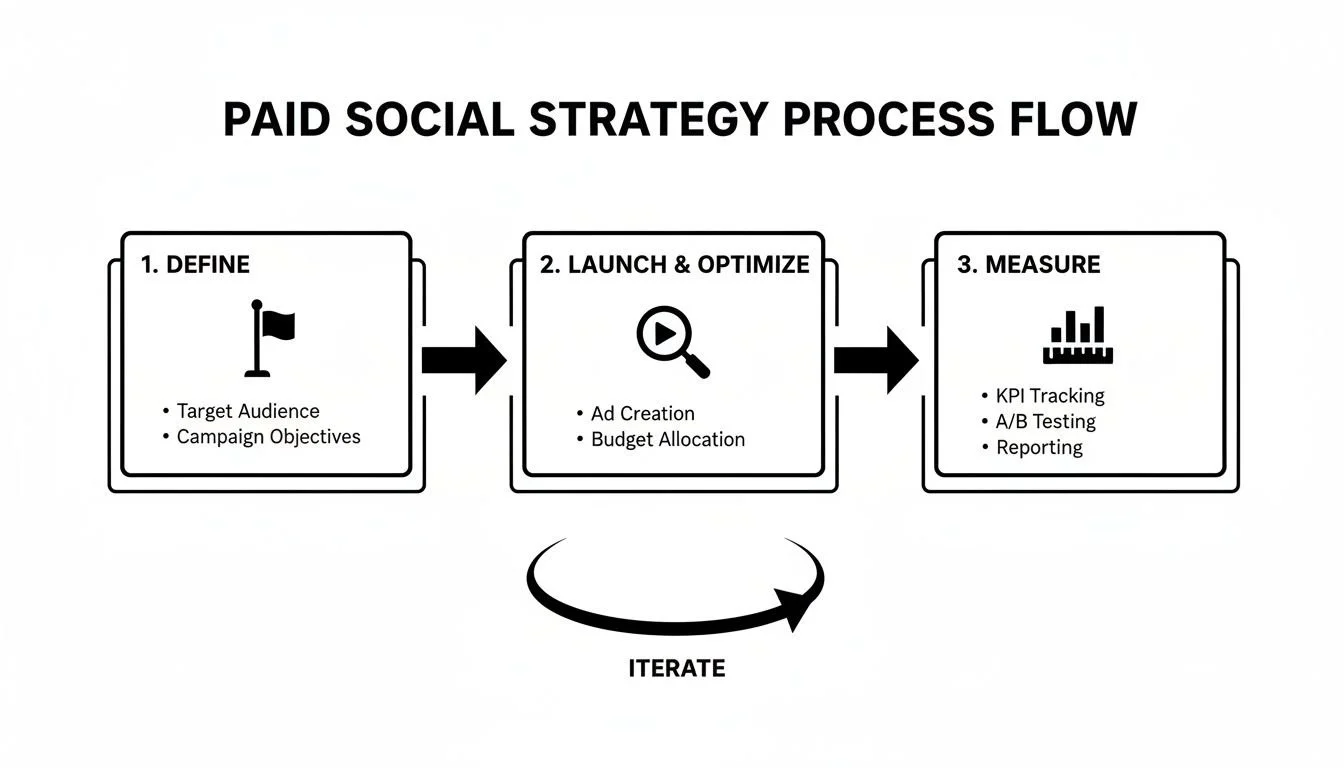
As you can see, a winning strategy isn't a "set it and forget it" job. It’s a constant cycle of defining goals, launching campaigns, measuring what happens, and iterating based on the data.
To understand why this matters so much, just look at the numbers. The UK's paid social advertising market is forecast to hit a massive £9.02 billion in 2025. It’s no surprise that Meta is still the dominant player, with 33% of UK marketers investing most of their budget there and 36% of businesses saying it delivers their best ROAS. With that much money flowing, you can't afford not to have a razor-sharp strategy.
To really nail this, you need a clear framework that covers all the essential components. We've broken them down into five core pillars, each with its own objective and key metric to keep you on track.
Core Pillars of a High-Performance Paid Social Strategy
This table summarises the essential components you need to build a successful paid advertising framework. Each pillar supports the next, creating a repeatable system for growth.
Pillar Primary Objective Key Metric Audience & Channel Find the most profitable customers on the right platforms. Cost Per Acquisition (CAC) Campaign Structure Build an account that scales efficiently and provides clear data. Return on Ad Spend (ROAS) Creative & Testing Develop high-impact ads that resonate and convert. Click-Through Rate (CTR) Budget & Allocation Spend money where it will generate the highest return. Blended ROAS / MER Measurement & Optimisation Make data-driven decisions to improve performance over time. LTV:CAC Ratio
These pillars aren't just theory; they are the building blocks of a system designed to turn ad spend into predictable profit.
A successful paid social strategy is built on a simple premise: spend money to make more money. If you can’t draw a straight line from your ad spend to your profit margin, you don’t have a strategy—you have an expense.
Ultimately, this blueprint is about marrying the art of compelling creative with the science of cold, hard data. This is the heart of what we call performance branding, where every campaign works double-duty: building your brand and driving sales you can actually measure.
Throughout this guide, we’ll walk through each of these pillars in detail, giving you a clear roadmap from deep audience research to building a powerful optimisation loop. Let's get started.
Finding Your Audience & Nailing Your Channel Selection
Let's be blunt: even the most jaw-dropping creative will fall flat if it’s shown to the wrong people. This is the stage where a paid social strategy is truly made or broken. Before you spend a single pound on ads, you need absolute clarity on who your customer is and where they hang out online.
We have to go deeper than basic demographics like age and location. Real performance comes from understanding the psychographics—the beliefs, interests, and online behaviours that signal someone is ready to buy. This insight is what lets us build audiences that are genuinely receptive to our message, which in turn drives up efficiency and ROAS.
Moving Beyond Basic Demographics
First things first, you need to profile your ideal customer with surgical precision. Don't just say "women aged 25-40". Get granular. What podcasts are they listening to on their commute? Which niche influencers do they trust? What specific problems are they trying to solve that your product or service is the answer to?
Your own data is the best place to start digging for these answers:
Website Analytics: Dive into Google Analytics and look at the affinity categories and in-market segments. What are your current visitors actually interested in beyond your own brand?
Customer Surveys: Just ask! A simple survey sent to your best customers about their social media habits can be a goldmine for targeting ideas.
CRM Data: Analyse your past buyers. Are there common threads in how they found you or what they bought first? This is pure alpha.
This research becomes the foundation for your first targeting hypotheses. For instance, a sustainable e-commerce brand might discover their best customers also follow a handful of specific eco-conscious creators on Instagram and read a particular online magazine. These are powerful, high-intent targeting layers that generic demographic targeting will always miss.
Your best audiences are rarely the most obvious ones. Digging into psychographics and online behaviours uncovers the high-intent segments your competitors are overlooking. It's the difference between shouting into a crowd and having a quiet, profitable conversation.
Crafting High-Intent Audiences
Once you've got a solid customer profile, it's time to start building audiences inside the ad platforms. The aim here is to create a small portfolio of different audience types to test against each other, letting the data tell you which segments are the most profitable. Your main tools for this are interest targeting and lookalike audiences.
Interest targeting is your starting block. Use the insights from your research to select highly relevant interests. My advice? Avoid broad categories like "fashion" and instead focus on niche interests like specific boutique brands, magazines, or events that your ideal customer would actively seek out.
But lookalike audiences are where the real power lies. These are audiences the platform's algorithm builds to mirror the characteristics of a 'source' audience you provide.
Website Visitor Lookalikes: Create audiences based on people who have visited your site, or even better, high-intent pages like a product or pricing page.
Customer List Lookalikes: Upload a list of your existing customers to create a powerful lookalike of people who share their traits. This is often the highest-performing audience for new customer acquisition, straight out of the gate.
Engagement Lookalikes: Build audiences based on users who have engaged with your social media profiles (liked a post, watched a video, etc.).
A crucial pro tip: the quality of your source audience is everything. An audience built from your top 20% of customers by lifetime value will almost always outperform one built from your entire customer list. Don't feed the algorithm junk data.
Choosing Your Core Advertising Channels
With your audiences defined, the next question is where to run the ads. The biggest mistake I see is spreading a budget too thinly across every channel from day one. Instead, focus your initial efforts on the one or two platforms where your audience is most active and receptive.
Here’s a simple framework to guide your decision:
Platform Best For E-commerce Best For B2B / Services Key Consideration Meta (Facebook & Instagram) Excellent for visually driven products and impulse buys. Unmatched lookalike audience capabilities. Strong for lead generation, especially for services with broad appeal (e.g., coaching, wellness). The most versatile platform, offering a huge user base and sophisticated targeting for almost any business type. TikTok Powerful for brands targeting Gen Z and Millennials with engaging, short-form video content. Effective for top-of-funnel brand awareness and reaching younger professionals in creative fields. The creative is everything. Your ads must feel native to the platform to succeed. User-generated style content often performs best. LinkedIn Limited direct e-commerce application, but can work for high-ticket items targeting professionals. The premier platform for B2B lead generation. Unbeatable for targeting by job title, industry, and company size. Expect higher costs per click and lead, but the lead quality is often significantly better for B2B objectives.
For any new paid social strategy, the smartest move is to start with the platform that offers the most direct line to your ideal customer. For most e-commerce brands and many service businesses, that’s Meta. For B2B, it's almost always LinkedIn. Master one channel first, prove it can be profitable, and then use those winnings and learnings to expand.
Structuring Campaigns for Rapid Testing and Scale
A disorganised campaign structure is the fastest way to burn through your ad budget and get murky, unusable data. If you want to learn quickly and scale efficiently, you need a deliberate architecture that gives different stages of the customer journey the respect they deserve.
This isn't just about keeping things neat; it’s about building a robust testing environment from the ground up.
At the heart of any strong paid social strategy is the separation of your ad efforts into distinct funnel stages. At a bare minimum, this means splitting your campaigns into two primary buckets: Prospecting (Top of Funnel) and Retargeting (Middle/Bottom of Funnel).
Prospecting campaigns are your engine for new customer acquisition. Their sole job is to reach cold audiences—people who’ve likely never heard of your brand before—and introduce them to what you do. Retargeting campaigns, on the other hand, focus on warming up those prospects, re-engaging past website visitors, and converting high-intent users already familiar with you.
Designing Your Prospecting Engine
Your prospecting campaigns are where the real work happens. This is where you validate audience hypotheses and discover which messages actually resonate with new customers. A classic mistake is lumping multiple audiences into a single ad set, which just muddies the data and makes it impossible to know what’s really working.
To avoid this, structure your prospecting campaign with isolated ad sets, each targeting one specific audience segment.
Lookalike Ad Sets: Give each of your high-value lookalike audiences its own ad set. For example, one for a 1% Customer List Lookalike, and another for a 1% Add to Cart Lookalike.
Interest-Based Ad Sets: Group related interests into thematic ad sets. You might have one targeting interests in Competitor A, Competitor B, and Competitor C, and another targeting interests in relevant publications or influencers.
Broad Targeting Ad Sets: With platform algorithms getting smarter, testing broad targeting is no longer optional—it's essential. This means an ad set with minimal demographic constraints and no interest or lookalike layers, trusting the algorithm to find your buyers. This approach is a key part of the move towards autonomous AI ads, a shift fundamentally changing performance marketing. You can learn more about Meta’s autonomous AI ads in our detailed guide to stay ahead of this curve.
By isolating these audiences, you get a clean read on performance. You can clearly see which segment delivers the best ROAS or lowest CPA, allowing you to confidently shift budget to your winners.
A clean campaign structure isn't just for organisation—it’s a scientific framework for discovery. Each ad set is a controlled experiment. If you mix your variables, you'll never get a reliable result.
The Power of Strategic Retargeting
Your retargeting structure should be just as deliberate, segmenting users based on their level of intent. A visitor who just glanced at your homepage is far less committed than someone who abandoned a full shopping cart. Treating them the same is a massive missed opportunity.
Consider a tiered approach for your retargeting campaigns:
Low-Intent Audience (The Browsers): Target all website visitors from the last 30-90 days who haven't taken a key action. The goal here is simple re-engagement and brand recall, often with top-of-funnel content or a broad brand message.
Mid-Intent Audience (The Engagers): This group includes users who've engaged with your social profiles or viewed specific product pages. Here, your messaging can be more direct, perhaps highlighting unique selling points of the products they looked at.
High-Intent Audience (The Almost-Customers): This is your most valuable retargeting segment. It includes users who initiated checkout or added items to their cart. The creative here needs to be hyper-focused on conversion. Address potential barriers like shipping costs with a free shipping offer or create urgency with a limited-time discount.
Finally, a quick but critical point on naming conventions. A chaotic list of ad set names like "Test 1" or "New Audience" will become a nightmare to manage. Implement a clear, consistent system from day one.
A simple format like [Region] - [Funnel Stage] - [Audience Type] - [Device] (e.g., UK - Prospecting - LAL1% Purchasers - Auto) makes reporting and analysis infinitely easier down the line. This disciplined setup is the bedrock of any paid social strategy built to scale profitably.
Developing Ad Creative That Stops the Scroll
In the endless river of social media feeds, your creative isn't just one part of the strategy—it's the single most important lever you can pull. You can have flawless targeting and a perfect campaign structure, but if your creative is mediocre, your performance will tank. Your ads have to earn every single second of attention.
This means moving beyond guesswork. You need a reliable system for producing and testing ad creative that genuinely connects with your audience and pushes them to act. The goal isn't a one-off viral hit; it's a repeatable process for generating killer ideas based on what your customers are already telling you.
Brainstorming Concepts Rooted in Customer Reality
The best ad concepts don’t materialise out of thin air. They come from listening intently to your customers. Your creative should feel like a direct answer to their problems, their hopes, and their hesitations. So before you even think about visuals, you need to get your hands dirty with customer data.
Mine your reviews. What specific words do your happiest customers use? A five-star review that says, "This finally solved my issue with X," is basically a headline that’s been written for you.
Analyse customer service tickets. Look for the most common questions or points of confusion. An ad that proactively answers a frequent question builds trust and dismantles a major barrier to purchase before it even forms.
Listen to sales calls. For service-based businesses, sales call recordings are pure gold. Pay close attention to the exact language prospects use to describe their pain points—that’s the copy you should be using.
Once you’ve done this research, you can start building out your core creative "angles" or hypotheses. A skincare brand, for instance, might spot three distinct angles from their customer feedback: one focused on the product's natural ingredients, another highlighting its power for sensitive skin, and a third showcasing jaw-dropping before-and-after photos.
Your customers are constantly telling you what they want to see in your ads. The strongest creative concepts are not invented; they are discovered by paying close attention to the voice of the customer.
This customer-first approach ensures your creative isn't just pretty but strategically potent. It speaks your audience's language and zeroes in on what they actually care about. That's the secret to stopping the scroll.
Creating for a Mobile-First World
Let’s be clear: your creative will almost exclusively be seen on a mobile phone. This isn’t a guess; it’s a certainty. With over 98% of UK users on social platforms via mobile, a mobile-first mindset is completely non-negotiable.
Video is especially vital. Just look at YouTube, where ad reach in the UK alone hits 54.8 million people. This data screams one thing: prioritise mobile-optimised, video-centric creative if you want to stand a chance. You can dig into more stats about UK social media habits on ceek.co.uk.
To create mobile video ads for platforms like TikTok and Instagram Reels that actually work, stick to these fundamentals:
Grab attention in the first 3 seconds. The opening shot is everything. Use bold motion, a surprising visual, or a direct question to hook them instantly.
Design for sound-off. Most videos are watched on mute, at least initially. Use clear on-screen text, captions, and strong visuals to get your message across without a single sound.
Use a vertical aspect ratio. Always shoot and edit in 9:16. It fills the entire screen, creating a much more immersive experience and avoiding those ugly black bars.
Keep it authentic and lo-fi. Overly polished, corporate-style videos often get ignored. Content that feels native to the platform—like a simple user-generated testimonial—builds trust because it feels real.
A Structured Framework for Creative Testing
Once you have your creative assets, it’s time to test them like a scientist. Just dumping a bunch of new ads into an ad set without a clear hypothesis is a recipe for messy data and wasted budget. The key is to isolate variables so you can understand what truly drives performance.
This is where a structured creative testing framework becomes your best friend. Instead of testing completely different ads against each other, you test small variations of a single core concept.
Here’s a simple, practical example of an isolated test:
Ad A (Control): A video ad with a customer testimonial and the headline "The Most Comfortable Trainers Ever."
Ad B (Headline Test): The exact same video, but with the headline "Say Goodbye to Sore Feet."
Ad C (Visual Test): A static image of the testimonial, using the original headline "The Most Comfortable Trainers Ever."
By running these three ads in the same ad set, you get clean, actionable answers. If Ad B beats Ad A, you’ve learned that a benefit-driven headline resonates more than a descriptive one. If Ad A smashes Ad C, you know video is the better format for this message. These small wins stack up over time, building a powerful bank of insights you can draw on.
This systematic approach is the engine of any successful paid social programme. For a deeper dive, check out our guide on building a creative testing system that constantly surfaces winners. When you turn creative development from a guessing game into a disciplined process, you build a machine that generates a continuous flow of high-performing ads. That’s how you scale profitably.
How to Measure, Optimise, and Scale Your Campaigns
Hitting ‘launch’ on a campaign is just the starting line. The real work—and where the real money is made—happens in the feedback loop. This is where you turn raw performance data into smart, profitable decisions.
Honestly, running ads without this loop is like flying a plane with no instruments. You’re definitely moving, but you have no clue if you're heading for a five-star resort or a mountain.
To get it right, we have to look past the vanity metrics like likes and shares. We need to zero in on what actually moves the needle for the business: Return on Ad Spend (ROAS), Cost Per Acquisition (CPA), and the bottom line, profit.
Building a Data-Driven Feedback Loop
First things first, get your measurement infrastructure sorted. Your Meta Pixel or TikTok Pixel needs to be firing correctly on every key conversion event—from page views to adds-to-cart and, most critically, purchases. Clean data is the bedrock of every good decision you'll make from here on out.
Once that data is flowing, you need a rhythm. For most brands, a weekly check-in is the perfect cadence. It gives the platform's algorithm enough time to learn and optimise, but it’s frequent enough that you can step in before any significant budget gets torched on a dud.
The goal of this weekly review is simple: figure out what’s working and what isn’t so you can reallocate your budget with confidence.
Every week, you should be able to answer three core questions:
Which campaigns, ad sets, and ads are bringing in the most profitable results?
Which ones are underperforming and just draining the budget?
Are there any emerging trends in costs or creative performance?
This regular pulse check becomes the foundation of your optimisation playbook—a set of clear, pre-agreed rules that guide your next move.
Your Optimisation Playbook: The Rules of the Game
To stop yourself from making emotional, knee-jerk decisions, you need an "if-then" playbook. This removes the guesswork and makes sure your actions are rooted in data, not just a gut feeling.
A simple but incredibly effective starting point looks like this:
The Kill Rule: If an ad has spent more than your target CPA without a single conversion, turn it off. It’s not working. Every pound spent after that point is just throwing good money after bad.
The Review Rule: If an ad's CPA is 1.5x your target, it's time to investigate. Don't kill it just yet. Is the click-through rate tanking? Is the frequency getting too high? This is your cue to troubleshoot.
The Push Rule: If an ad set is consistently smashing your target ROAS or CPA, you’ve found a winner. This is where you should be funnelling more of your budget.
A winning paid social strategy isn’t about getting everything right from the start. It’s about having a system to quickly and ruthlessly cut your losses while doubling down on your winners. Data gives you the permission to be decisive.
Your playbook should evolve as you collect more data. Over time, you might add specific rules for creative fatigue. For example, you could set a rule to automatically swap out an ad once its frequency hits a certain number (say, above 5 in a retargeting audience).
To help guide your weekly review, I've put together a simple checklist.
Weekly Optimisation Checklist
This table is a great starting point for your weekly health checks. It keeps you focused on the metrics that matter and gives you a clear path to action.
Metric to Review Good Signal Bad Signal Action to Consider ROAS/CPA At or above target. Significantly below target. Increase budget for winners; turn off losers. Click-Through Rate (CTR) Stable or increasing. A sudden drop. Refresh the ad creative or test a new headline. Cost Per Click (CPC) Stable or decreasing. A steady increase. Check audience saturation or competitive pressure. Frequency Below 3 (Prospecting) / Below 8 (Retargeting). Rising rapidly. Introduce new creative to combat ad fatigue.
Following this kind of systematic process turns you from a passive spender into an active investor, constantly rebalancing your ad portfolio for the best possible returns.
How to Scale Your Campaigns Intelligently
Once you've found a few consistent winners, the temptation is to just crank up the budget. Big mistake. A sudden, massive budget increase can throw the algorithm for a loop, force it back into the learning phase, and send your CPA through the roof.
Smart scaling is a gradual, controlled burn.
The most reliable way to do this is vertical scaling. This means taking a proven ad set and increasing its budget by 20-30% every 48-72 hours, but only as long as performance holds steady. This gentle increase gives the algorithm time to adjust and find new customers without torpedoing your profitability.
Another method is horizontal scaling, which is all about expanding your reach by targeting new audiences. If your lookalike audience of past purchasers is performing well, you could test a new lookalike of people who added items to their cart or high-value website visitors. This lets you scale your total spend by finding new, profitable pools of people, rather than just hammering the same audience with more cash.
At the end of the day, scaling isn't just about spending more money. It's about growing your ad spend without your efficiency falling off a cliff. This disciplined approach to measurement, optimisation, and scaling is what drives sustainable growth and turns paid social into a true performance engine.
Common Questions About Paid Social Strategy
Even with the best-laid plans, questions always pop up once you start running paid social campaigns. That’s perfectly normal. This game changes fast, and what crushed it last quarter might need a total rethink today.
We get these questions all the time from founders and marketing leaders. So, we've put together some straight-talking answers to the most common ones to help you cut through the noise.
How Much Should I Spend on Paid Social Ads?
This is the classic "how long is a piece of string?" question, but there's a logical way to get to a starting number. Forget pulling a figure out of thin air; your budget should be tied directly to your business goals.
First, define a crystal-clear objective. Let's say your goal is to land 50 new customers this month.
Next, you need to know your numbers. What’s your maximum acceptable Cost Per Acquisition (CPA)? If your average order is worth £100 and you need to maintain a 50% gross margin, then your absolute ceiling for a new customer is £50.
The maths from there is simple: 50 customers x £50 CPA = a £2,500 test budget.
A decent rule of thumb for many brands is to start by putting 10-20% of your total marketing budget towards paid social. But honestly, the most important thing is to start small. Prove you can get a positive return with a manageable budget before you even think about hitting the accelerator.
Which Social Media Platform Is Best for My Business?
The best platform is wherever your customers are hanging out. Simple as that.
One of the costliest mistakes we see is brands spreading their budget thinly across every channel from day one. You have to be strategic. Pick your battleground.
Here’s a quick cheat sheet:
B2B Services & High-Ticket Products: If you're selling to people based on their job title, industry, or company size, LinkedIn is in a league of its own. It’s pricier, sure, but the quality of leads you can generate is often miles ahead of anywhere else.
E-commerce & Visually-Driven Brands: Meta (Facebook & Instagram) is still the undisputed heavyweight champion here. Its targeting and lookalike audience tools are incredibly powerful for finding new buyers, especially if your product has broad appeal.
Brands Targeting Younger Demographics: If your audience is mostly Gen Z or younger Millennials, you have to be on TikTok. But you can't just run standard ads. Success there is all about creating authentic, engaging, short-form video that feels like it belongs on the platform.
Ultimately, your own audience research should guide you. Nail your strategy on one or two core platforms first. Once you've got a model that works, then you can start thinking about expanding.
How Long Until I See Real Results?
Patience is a virtue in paid social. It's a marathon, not a sprint.
You'll see surface-level data like impressions and clicks almost immediately, usually within 24-48 hours. This early feedback is great for a quick health check to make sure everything is running correctly.
But the results that actually matter—like a stable and profitable Return on Ad Spend (ROAS)—take time.
You need to give the platform’s algorithm at least 2-4 weeks to work its magic and exit the "learning phase." During this time, you're gathering the conversion data needed to make smart decisions. Building a truly predictable growth engine often takes 3-6 months of consistent testing and refinement.
It's also worth thinking about influencer marketing, which has become a serious performance driver. The UK market alone has hit USD 2.36 billion, and more importantly, 69% of UK consumers have bought something after seeing an influencer promote it. This shows that paid collaborations can be a massive win, especially when your audience trusts authentic recommendations. You can dig into more stats on the rise of influencer marketing in the UK on goviralglobal.com.
Ready to build a paid social strategy that drives real, measurable growth? The Growth Guys specialises in turning ad spend into predictable profit for ambitious brands. Book your free strategy session today and let's scale your business together.
Article created using Outrank
